Schuetzen is a German gift to America — a tradition of offhand marksmanship, fine rifles, and good fellowship, carried across the Atlantic and raised here to a golden age. Here is that story: where the sport came from, the notorious American rifles and the men who made them shoot, and how you can join the line today.
A German Tradition, an American Golden Age
The Schuetzenfest was born in the German-speaking lands of Europe — Germany, Switzerland, and Austria — where the Schützenverein, the village shooting society, had gathered communities for matches, feasting, and fellowship for centuries. It was never only about the shot; it was about Gut Schuss und Kameradschaft — good shooting and good company.
When waves of German immigrants crossed the Atlantic in the nineteenth century, they carried the tradition with them. By the years after the Civil War, Schützenvereine had taken root across German-American communities — from New York and Cincinnati to Milwaukee, St. Louis, and San Francisco. The American Schuetzen movement flourished, and with it grew a hunger for ever-finer target rifles.
American makers answered as no one had before. The Ballard, the Stevens, and the Winchester High Wall — single-shot rifles built to a standard of accuracy and craftsmanship the world had not seen — became the tools of the sport, and champions like Harry Pope became legends of the offhand line. The golden age ran from roughly 1865 to 1917.
The anti-German sentiment of the First World War dimmed the great Schützenvereine, and the sport faded from much of American life. But the rifles survived, the records still stand, and the tradition endures wherever shooters stand on their hind legs and fire offhand. Northern Plains Schuetzenfest carries it forward.
The Classic Schuetzen Rifles
The Schuetzen rifle is a single-shot — one deliberate, perfect shot at a time, fired offhand. Three American actions defined the sport, and all three are still revered.
The Ballard (Marlin-Ballard)
Charles H. Ballard of Worcester, Massachusetts patented his lever-operated falling-block action in 1861. After passing through several makers it came to John Marlin, and from about 1875 to 1891 the Marlin Firearms Co. built the finest Ballards ever made. The dedicated target grades — the No. 6½ Off-Hand and the double-set-trigger Union Hill No. 8 and No. 9 — became the classic American offhand guns, prized for their deep "Ballard rifling" and their accuracy. Many of the greatest wore barrels fitted by Harry Pope.
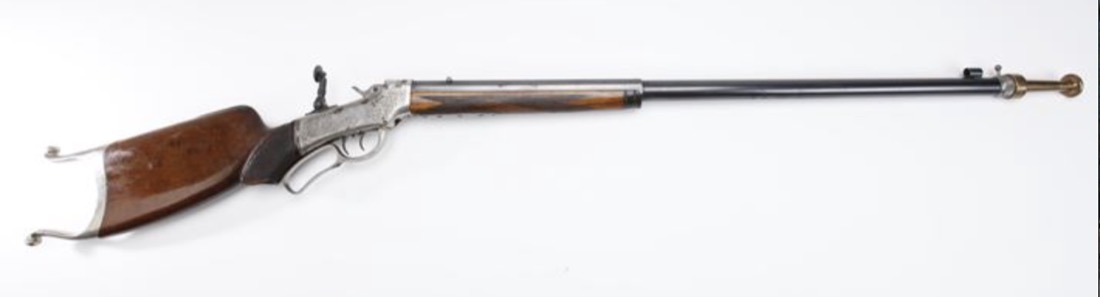
The Stevens 44 & 44½
Both come from the J. Stevens Arms & Tool Co. The No. 44 (from about 1894) is a lighter rocking-block action of cast construction — fine for black-powder target cartridges. The No. 44½ (introduced about 1903–04) is the one serious shooters covet: a true, forged falling block, far stronger and built for smokeless-powder pressures. You can tell them apart at a glance — when the action is open, the 44½'s breechblock drops below the frame; the 44's does not. Only some 13,000 of the 44½ were made, and it is the pattern most often reproduced today.
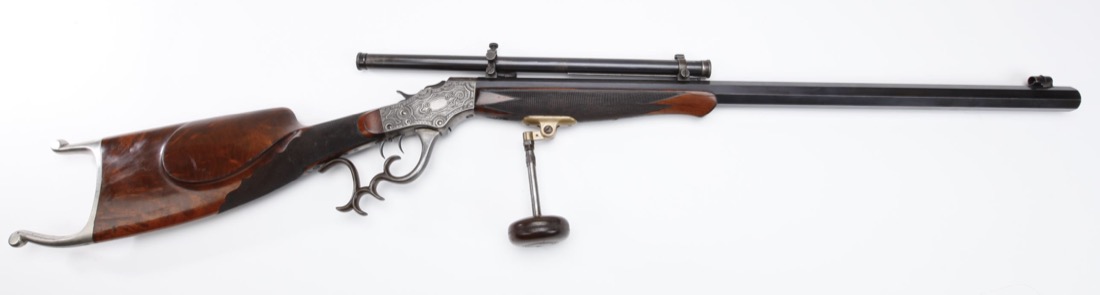
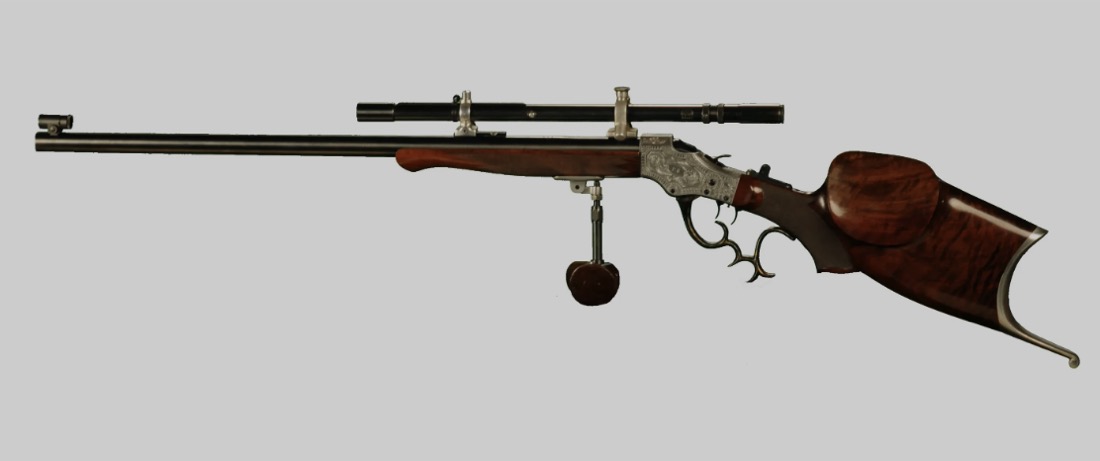
The Winchester Model 1885 — High Wall & Low Wall
Designed by a young John M. Browning (patented 1879) and Winchester's very first single-shot, the Model 1885 is one of the strongest actions of its era. The High Wall — its receiver sidewalls rising to shroud the breechblock — was built for larger, higher-pressure cartridges and was Winchester's choice for its dedicated Schuetzen rifles. The Low Wall, with lower walls and an exposed hammer, handled smaller rounds including the .22 rimfire — which makes it the direct ancestor of the affordable rimfire single-shots a newcomer can buy today.
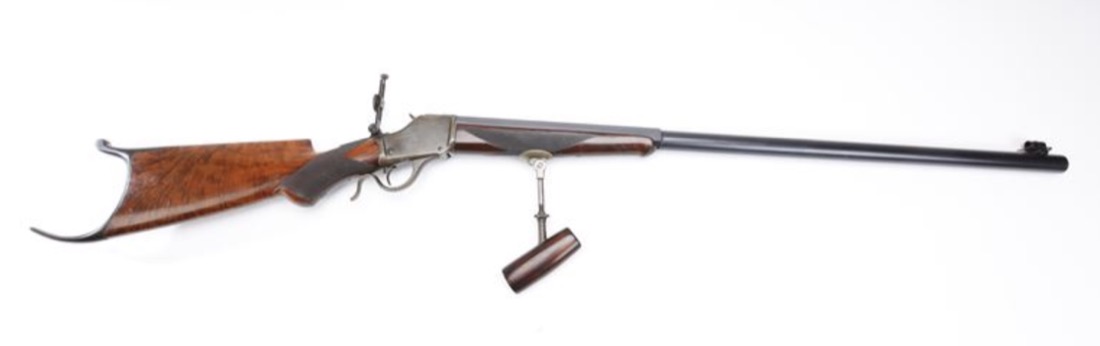
The Target Scopes — and an Uncommon Maker
The finest Schuetzen rifles often wore a long, slender external-tube telescopic sight — a steel tube running nearly the length of the barrel, adjusted for windage and elevation by micrometer mounts at each end. The celebrated names were William Malcolm of Syracuse, New York and the house scopes of Stevens and Winchester (the A5); after the golden age, J. W. Fecker and John Unertl carried the tradition into the twentieth century.
But one uncommon maker deserves his due. Lawson Cutler Cummins of Montpelier, Vermont introduced his target scope — sometimes called the "Duplex" — in 1887 and worked on into the early 1900s. His was among the first American scopes to carry its adjustments in the instrument itself, worked by small thumb-screws, rather than relying solely on moving the whole tube in its external mounts — a genuinely advanced idea for the day. His U.S. patent (No. 476,874, granted June 14, 1892) describes a two-line reticle with a tiny balsam globule at each focus and a pivoted steel needle, so the marksman could hold off for angle and still see exactly where the bore was pointed. Because so few were built, Cummins scopes are scarce today — they surface now and then atop a special-order Winchester High Wall or a fine Schuetzen rifle, and are prized precisely for their rarity.
Harry Pope — The Old Master
Northern Plains Schuetzenfest dedicates this page to the man who, more than any other, made the American Schuetzen rifle shoot.
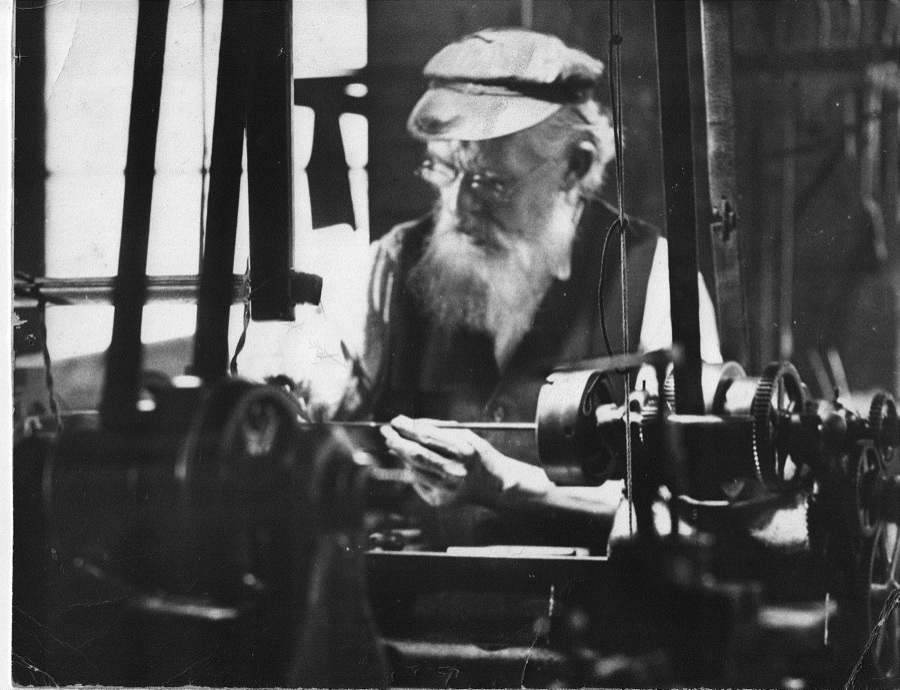
Harry Melville Pope (August 15, 1861 – October 11, 1950) was, in the words of the NRA's own museum, "judged to be the finest American barrel maker" of his time. Born in Walpole, New Hampshire and a 1881 mechanical-engineering graduate of MIT, he learned metalwork in his uncle's bicycle factory before devoting his life to the rifle barrel.
It is important to understand what Pope did: he made barrels, not actions. He fitted his barrels to the best actions of the day — the Ballard, the Stevens, the Winchester 1885, the Remington-Hepburn. His rifling was unmistakable: eight grooves, wide and shallow (~0.004″ deep) with narrow lands and a gain twist that accelerated toward the muzzle. From 1901 to 1905 he worked inside the Stevens factory, and the celebrated "Stevens-Pope" rifles date from those years; he is credited with helping develop the stronger Stevens 44½ action for the smokeless era. (The exact extent of his design role in the 44½ is debated by historians — it is fairest to say it was developed at Stevens with Pope's involvement.)
His great innovation — the Pope loading system
Pope's fame rests on a method as much as a barrel. Rather than chamber a finished cartridge, he loaded the bullet from the muzzle — pushed down through a precisely fitted, removable false muzzle that guided it perfectly true — and loaded the powder charge separately from the breech. Seating the bullet base-first this way left its base perfectly square and concentric with the bore, undeformed by being rammed into the rifling. The result was accuracy that has become legend.
His rifles carried the full offhand kit of the age: a folding palm rest beneath the forearm, a hooked Swiss-style buttplate, double-set triggers, and tang-mounted Vernier peep sights, globe front sights, or long external-tube telescopic sights.
The records
Pope was a champion, not merely a maker. His most famous feat, at Springfield, Massachusetts on April 9, 1897, was a 100-shot offhand string of 917 (out of a possible 1,000) at 200 yards on the Standard American target — near the end, several shots went through the same hole, driving out a plug the scorer had set. In the 1904 season he posted six 10-shot scores of 97 and twenty-one of 96 at 200 yards offhand, and on the German Ring target he made ten separate 3-shot scores of 74 out of 75. (These figures are drawn from period accounts and Pope's own writing; we present them as they have long been reported rather than as certified world records.)
"Stand on your hind legs and shoot like a man." — Harry Pope, on shooting offhand
Getting Started — Rifles & Sights You Can Buy Today
New to the sport? You do not need a museum piece. You have two paths: an original antique (a specialist purchase — have a knowledgeable collector help you) or a modern reproduction built new to the old patterns. For most newcomers, a reproduction is the sensible way in. Here's the honest landscape.
Rifles
| Maker / Rifle | What it is | Fits which class |
|---|---|---|
| Winchester / Miroku 1885 Low Wall Rimfire | Current factory .22 LR falling-block, ~$1,670. The most affordable, buy-it-today period-style single shot. | Iron or Scope (as sighted) |
| CPA Rifles — Stevens 44½ Schuetzen | Faithful reproduction of the prized 44½, built to order in .22 LR and classic calibers. ~$3,500–4,100. The go-to true Schuetzen rifle. | Iron or Scope |
| C. Sharps Arms — 1885 High/Low Wall | U.S.-built 1885 in many chamberings including .22 LR; Schuetzen configuration on request. From ~$2,250. | Iron or Scope |
| Ballard reproductions | Still built in Cody, WY (Wyoming Armory). Mostly centerfire target builds — call to confirm current options. | Iron or Scope |
| Uberti / Cimarron / Pedersoli 1885 High Wall | Well-made imported High Walls — but centerfire only (.45-70, .38-55). Not a .22 option. | — |
Original Stevens 44½, Ballard, and Winchester High Wall Schuetzen rifles turn up on the collector market from roughly $1,000 into the five figures for fine examples — always worth having an expert look first.
Optics — for the Vintage Scope & Open classes
The original Unertl company closed in 2008, so a new Unertl isn't available — but excellent reproductions are. Hi-Lux "Wm. Malcolm" makes external-adjustment steel-tube target scopes with the correct period look: a long-tube 6× (~$779) and a 20× Unertl-style target scope (~$849). Montana Vintage Arms (MVA) builds premium tube scopes ($1,000+). Remember the class rules: Vintage Scope is a ¾″-tube period scope at 10× maximum; Open (indoor 50-foot matches) removes the power limit.
Iron sights — for the Vintage Iron class
A tang-mounted Vernier (peep) rear sight plus a globe front sight is the classic setup. Montana Vintage Arms is the specialist (Vernier tang sights ~$260–330, globe fronts $115+). The Lyman No. 17A globe front (~$50–70) and Lyman tang sights are the budget-friendly, currently-made option; Pedersoli and Lee Shaver make fine sights as well.
Rough budget
| Item | Reproduction (new) |
|---|---|
| Rimfire single-shot (.22) | ~$1,300 – $4,100 |
| Period tube target scope | ~$780 – $850 (Hi-Lux) · $1,000+ (MVA) |
| Vernier tang + globe front sights | ~$100 (budget) – $650 (premium set) |
Prices are approximate and drift — always confirm with the maker before buying.